How to Build a Hedge Fund Target List


You discovered this world called the hedge fund and you want in.
The most common mistake people make at this point is sending applications to every fund with a pulse. Yes, you need volume, but unless you have a stellar background on paper, blanket applications get you nowhere fast.
Appaloosa, Point72, Elliott, Farallon - each wants something completely different. Hell, each team within some of these firms wants something different because they are multi-strategy. And you're probably not the Princeton undergrad who got plucked directly into Blackstone, which means targeting only brand-name shops is its own dead end.
You're stuck in no man's land. You know the destination. You have no map.
Here is the map.
Know What Kind of Investor You Are
Most people, even current buy-siders, fail to get a hedge fund job because they treat all funds as interchangeable. They're not. Every serious investor firmly believes in the way they invest – they have defined no-go market cap ranges, no-go sectors and styles they consider intellectually bankrupt.
Pitching a short to a long-only? Amateur move. Pitching a compounder idea to a deep value fund? No no. Pitching a beaten-down cyclical to a hypergrowth shop? No no. In each case, the person you are talking to knows they will never put on the position if you work for them, so they will not hire you.
Style also shapes what skills a fund values in a junior hire. Activists, event-driven, Tiger style funds like IB/PE types. Pod shops are open to sell-side research associates because of their sector expertise and experience covering a subsector. Wide moat shops might even hire an investigative journalist with deep primary research skills. The point is: trying to land somewhere your background doesn't fit is a waste of everyone's time.
I categorized public equity funds across three dimensions:
- Product category: long-only, directional long/short, or low-net/market-neutral. Most hedge funds are long/short. People who came up through pod shops tend to run their own firms as low-net / market-neutral, though some long-only veterans do too. After all, people start their own firm because they want to do things differently than how their ex-employer operates. Chris Hohn did not believe in Richard Perry’s low-net approach. Yen Liow didn’t believe in Ziff Brothers' market-neutral approach.
- Style category: activist, event-driven, growth, low-net/market-neutral, Tiger style, value. Activists, event-driven shops, and Tiger-style funds tend to favor candidates with IB or PE training. Low-net and market-neutral funds are more open to sell-side analysts already accustomed to covering an industry.
- Sector focus: consumer, energy, financials, healthcare/biotech, TMT, real estate. Very straight forward.
- I have a style primer for you to reference.
Building Your Target List
AI tools like Claude make it easier than ever to compile a target hedge fund list.
For example, if you want to work at a healthcare-focused hedge fund, you can prompt something like:
Give me a list of hedge funds that invest in healthcare sectors - include fund name, founder name, their work history including both non-finance and finance jobs, their degrees, and headquarter location.
You'll get something useful. Unfortunately, some of the data are just wrong. That's why any AI-generated list needs your verification and primary work. But it’s a start, and you repeat the exercise for each style and geography you're targeting.
Once you have that list, go deep on each fund. For funds that file Form ADV Part 2 ($100M+ in regulatory AUM), that document alone is a goldmine most candidates ignore.
- The cover sheet tells you where they're headquartered.
- Item 4 shows office locations and who are the key people - in D1 Capital Partners' case, that's Dan Sundheim, who is your decision maker.
- Item 5 reveals the fee structure.
- Item 7 shows what kinds of LPs they have: endowment, pension, insurance companies, high net worth, etc.
- Item 8 is where it gets really useful: investment style, sector focus, long-only versus long/short, position sizing, research process, whether they run sector specialists or generalists, gross and net exposure ranges, that’s when you discover Lone Pine and Viking Global lets talented juniors run sleeves.
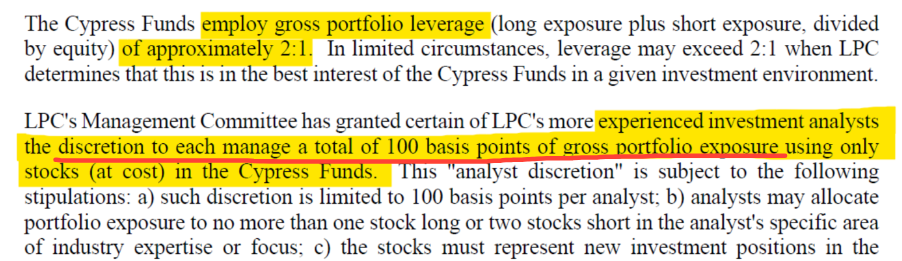
Layer that with everything else that's publicly available. Institutional Investor, Bloomberg, and the Wall Street Journal profile funds regularly. Hedge funders are increasingly going on podcasts to share their upbringing and what shaped how they invest. More primary material exists today than at any point in history. No excuse for you.
The Overlooked Edge: How to Relate
Hedge fund hiring is deeply personal. These are small, tight-knit organizations. When a firm hires someone junior, they're inviting you into a family. Families care as much about fit as competence.
You need to identify every possible point of connection with the hiring decision manager - in most cases, the founder / CIO and, if the firm is large enough to have one, the Director of Research.
Here are the angles you can relate with the key people:
- Personal background - hometown, ethnicity, gender
- Alma mater - if you share the same undergraduate institution as a founder, that's a real opening. If you did MBA there and the founder has an undergraduate, counts too, though probably slightly less affinity. Any shared credential - CFA, CPA - is still something.
- Work history - if you did the same banking program, covered the same sector on the sell side, worked at the same prior fund, that's a direct bridge
- Athletics - Kelly Granat, co-CIO of Lone Pine Capital, publicly said she likes hiring athletes. She played collegiate tennis. If two 2+2 candidates are otherwise equal and one played tennis, that candidate has a leg up.
- Personal interests – never forget a hedge fund founder is a human being. They have unique interests. And so do you. You never know what makes you two click
- Demonstrated skills - Dan Sundheim has spoken about how much he values candidates with strong communication skills. A genuinely well-written cold email landing in his inbox is not nothing
Even the people who built this industry got their start through a connection that looked improbable from the outside.
- Art Samberg, founder of Pequot Capital, got hired at Kidder Peabody because the Director of Equity Research, who was an engineer, took a chance on Samberg, who had studied aerospace engineering and worked at Lockheed on satellite control systems.
- Frank Brosens, founder of Taconic Capital and one of the “Rubin cubs”, got into investment banking at Goldman Sachs because the partner who hired him was also an engineer. And he was colleague of J. Christopher Flowers, the famed founder of the financial specialist PE firm J.C. Flowers & Co.
- Peter Lynch got his foot in the door because he caddied for the President of Fidelity.
- Bill Hwang got to Tiger Management because he covered Julian Robertson at Peregrine Investments Holdings, and Robertson knew who he was.
The pattern is consistent across decades: For most of you (including myself) without pedigrees, the way in to the hedge fund world is through genuine human connection, provided you know your sh*t.
Why Lineage Matters
The hedge fund industry didn't emerge from nowhere.
Alfred Winslow Jones started the first hedge fund as a multi-manager platform. Jones was a journalist; he didn’t know how to invest. So he hired people who picked stocks within his market-neutral framework charging 2/20. George Soros, Michael Steinhardt, Julian Robertson, and Jack Nash followed.
What matters now is understanding the family trees those pioneers created, because apples rarely fall far from their trees stylistically.
Knowing these lineages isn't trivia. It's the research that lets you walk into a conversation with a fund and speak intelligently about how they think, what they care about, and why your background belongs in that room.
Some of the major lineages that I have uncovered that shape the hedge fund industry for now (it's always a work-in-progress):
- Tiger Management - Coatue, Lone Pine, Viking Global, Maverick
- Goldman Sachs Risk Arbitrage - Farallon, Eton Park, Perry, ESL, Och-Ziff.
- Soros - Duquesne, PointState, Karsch.
- Commodities Corporation - Tudor, Caxton, Moore. Paul Tudor Jones, Louis Bacon, and Bruce Kovner, the macro GOATs, once worked at the same shop.
- Pequot - PFM, Islet, Tamridge.
- Ziff Brothers - Hound Partners, Crescent Park.
- Harvard Endowment - Highfields, Adage, Solel, MFN, Chronometer
- Mercury Asset Management - Paul Marshall (Marshall Wace); Peter Davies, Stuart Roden (run Lansdowne's UK equities fund); Patrick Degorce (TCI co-founder); Edoardo Mercadante (Parvus Asset Management).
- Fidelity - ValueAct, Vinik, Whalerock, Atreides
That's exactly what my fund database and deep dives are built for.
The fund database covers 650+ hedge funds and 350+ long-only’s, each profiled across the parameters that matter for your job search. Quarterly updates mean you're not working from stale information, and the funds that don't make it into an AI prompt are often the ones most willing to take a chance on a candidate who doesn't have the perfect pedigree - because they don't have the publicity to be selective about it.
The hedge fund history series gives you stories of how the legends of the industry – The GS risk arb, Pequot, Ziff Brothers and the likes - shaped the funds that are still running money today. Understanding those lineages tells you not just who trained where, but how investment philosophy gets passed down - and what a fund in front of you today is probably still doing because of where its founders came from.
The map exists. Get access today so you spend less time researching funds and more time building targeted pitches and getting in front of the right people.
Hope this is helpful. Thanks for reading. I will talk to you next time.
Want my insider takes?
8,000+ readers get my weekly insights on public equity research.

