
Your First Year in Equity Research (Part 2)

Estimated reading tie: ~10 minutes
Continuing from last week's article, let's talk more tips on how you can become more effective as a junior sell-sider.
Topics:
- You don't get better as an investor on the sell-side, unless you want to
- You need to own your coverage
- You have less time today from doing to interpreting, because of AI
- You need to be marketing, always
- You should develop great fundamentals before using AI
- You can always, always be more efficient
Let's dive in.
Investor mind is earned
I get this question constantly — "how many years do I need to stay on the sell-side before I can go buy-side?" There's no magic number, you might be ready now or you may never make it to the buy-side. The only certainty? Staying longer on the sell-side won’t make you a better investor.
For the first two years on the sell-side, you are learning about the industry and companies within, about the company management, what moves stocks, how investors think about your companies. But after that, the skills you need to succeed on the sell-side have little to do with being a good stock picker. Writing initiations, managing relationships, selling your views, don't have much to do with forming quality views that make money in mispriced stocks.
If you want to go buy-side, you have to invest your own time to gain skills that are outside your job description.

There was a guy who sat next to me when I was on the sell-side — a quintessential "closet buy-sider." We would lose track of time chatting about businesses, stock ideas and great investors. That curiosity was contagious.
I'm not saying you need to be that obsessive as we are. But if you don't have genuine curiosity about investing, that will catch up with you fast on the buy-side. If you think your sell-side boss is hands-off, wait until you meet your future PM. They're not going to beg you for ideas. If you're not making money for them, you will be replaced by someone who will.
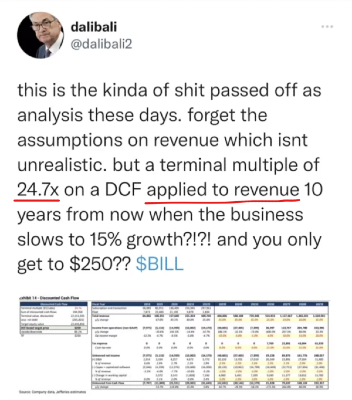
Here's what you should be doing while you're still on the sell-side: discover your investment style. Cover the companies as if you are a buy-side analyst – who is the winner, who is the loser, value them properly (not what’s the picture below) and why. You have valuable access – you can get feedback on your views both from the market and from buy-siders whose opinion you value. Over time, you get better at calibrating your views and earning respect from the buy-siders, which can be a way into the buy-side.
One important caveat: when you talk to buy-siders on the job, you can only share your team's view. Sharing personal views while representing your firm is a regulatory violation. You want to grow as an investor while keeping your sell-side job, I presume.
Own Your Coverage
You should operate like a founder.
Eventually, you will be responsible for a basket of stocks that you know better than anyone else at your firm. That's the job. The question is how seriously you take it.
Even if the buy-side isn't your goal, you need to grow on your own. Most seniors are too busy to push you - the bad ones just churn-and-burn you and the good ones are too busy to care. If you're self-motivated, they trust you to get to where you want on your own. If you're not, you will drift out of the industry.
Here's what you need to do: read about your industry, follow company news, dig into sector publications, talk to experts, and do all of it with a clear purpose: understand what happened in the past and where things stand today, and form a well-reasoned view on where the industry and its companies are heading.

Learning a company's past is actually the easiest part, and it's enormously valuable to buy-side clients who call looking for context — you save them time.
Go through your team's old notes and the company's earnings transcripts and public filings, and pay close attention to the moments where something changed. Take a CPG company that grew at or above GDP for decades, with obvious exceptions like 2008 and COVID. But in 2017, the industry grew 3% and this company revenue declined 5%. Why? Investors use the outliers as a pattern recognition tool to stress-test a position before they put it on — thinking through what could go wrong before they commit. If you can walk a client through those stories fluently, you add a lot of value.
Being "on top of" your coverage doesn't happen suddenly. It's a habit developed day by day. Follow the news on your stocks. Practice active reading — form a view on how a news impacts the business and stocks, and then track whether you were right. That feedback loop is how your instincts sharpen over time.
As your pattern recognition develops, pitch ideas to your analyst. If you think a stock is too cheap to ignore and end markets are turning positive, pitch your boss to upgrade it. If five clients ask you the same question over two days, propose writing a note that addresses what the market is getting wrong.
That's how you add value to your team, that's how the team adds value to buy-side clients.
Get to interpretation ASAP
With AI in the picture, the pressure to go quickly from Excel monkey to real value add is higher than ever.
Buy-side clients use the sell-side for fewer and fewer things – they can get cleaner pre-built models from independent vendors. They can get research from newsletters run by ex-buy siders.
You need to get to adding values to clients ASAP. Build models from scratch so you know what drives your companies and makes you faster at executing earnings updates, but more importantly, makes you credible when clients ask questions about financial performance.

The sooner you are solid on the technicals, the sooner you can focus on what actually matters: industry expert, company historian, ecosystem relationships and debate on the future. That's what people will pay for regardless of what AI can do, because quality judgment and human relationships are still hard to replicate.
So whenever you are doing a task, always ask yourself, why and so what? What does this mean for the business and for the stock? How is this note or analysis supposed to help clients? Making that a habit on every single task — no matter how routine — is what separates you from the people who just blindly do work.
Always Be Peacocking
When I was on the buy-side, I saw my PM's inbox was flooded with 20+ emails from equity salespeople across different brokers, each pitching their firm's top research. He'd open maybe three each day. He knew what he was looking for and just didn't have time for the rest. If your firm's sales email consistently lands in the other 17, your days on the sell-side are numbered.
Marketing yourself isn't optional — it's mandatory when the sell-side product is commodity (we saw the race to the bottom of standalone research subscription post MIFID II).

Ultimately, you either build a brand or sell-side research is a dead end job for you. Sell-side research is a business of selling ideas, and that favors people who are comfortable being visible.
Extroverts like myself have a natural edge here. I was always walking the floor, stopping to chat with associates and analysts from other teams — oil, banks, consumer, chemicals, didn't matter. If they were interesting and kind, I wanted to hear how their industries worked and share my story.
After market close on a Friday, go to the trading floor and say hi to the sales people, the traders, and others you will work with daily. Listen to what's on people's minds, whether it's personal or job-related.
As you just get past the "just doing work phase", equity salespeople start voting on you, which directly impacts your bonus. Those votes aren't purely about research quality – people vote for analysts they like. Consistent internal support is what gets your research "sold" to buy-side clients, which is when you can start building an external brand with buy-side clients.
From there, the channels expand — TV, podcasts, conferences, newsletters. But all of that starts with learning to be visible within your own firm first.
If you're an introvert, I have good news. You are not doomed. Let your work do the talking. Think about what problems your clients have, and solve them better than anyone else. There was a senior analyst at my internship who would walk past me every morning, eyes straight ahead, never making eye contact. I wasn't offended — I was fascinated. Someone with that personality was thriving on the sell-side, which told me his work had to be exceptional.
A mine-by-mine demand and supply model. Legal liability analysis based on precedents? End market channel checks for industrial distributors? The opportunity to add value is endless – just think about how do I save buy-side clients time or make them money.
Keep It Old School
If you have studied another language, you understand the importance of good grammar and vocab foundation as you progress to the next course. I think the same way about learning everything in life. Elon Musk, the most remarkable founder in our generation, calls it "first principles", but the idea is the same.
I believe you should develop good fundamentals, especially as LLMs begin to embed into people's daily work lives, because a good foundation helps you get the most out of AI and avoid making mistakes because of overreliance on it.

Write your notes yourself first. Okay to use AI to proofread, not to draft. Some of the most successful analysts — including II Hall of Famers — are English majors who built a brand because they write well and tell a story.
Most sell-siders aren't elite stock pickers. Many have long careers and make good money simply because they communicate exceptionally well. AI slop should not carry you, and neither will stating the obvious (stop publishing a note on a company’s press release without discussing the "so what" to your coverage).
Build your models in Excel. Start from a blank spreadsheet at least once for each company you cover. There is no better way to understand how the three statements connect, and more importantly, how to identify the revenue and cost drivers specific to your sector. You have already seen your team's models are full of named ranges that are #REFs and all the analysis that doesn't feed into other parts of the model just clouds what really drives the model.
I understand things move fast on the sell-side and you'll use AI to get tasks done — that's fine. But do the work the slow way on your own time too, because strong fundamentals come from deep reading. Learn to properly read a 10-K. Read the original documents yourself — front to back. LLMs aren’t guaranteed to surface every key point, and that one overlooked detail can become the core of a thesis. More importantly, doing it yourself trains your judgment, which is one of the very few things that will protect you from obsolescence.
The same principle applies to note-taking. You don't need fancy tools. Word and OneNote are more than sufficient.
For low-value tasks that require no judgment, use AI — no brainer. But for anything involving forecasts or opinions that clients are paying your team to produce, think twice. Buy-side clients also use AI. If you hand them LLM output and call it research, you will embarrass yourself.
Workflow, Workflow, Workflow
Every team has a set of recurring research notes — at minimum, an annual outlook. In practice, the annual outlook report is largely a search-and-replace exercise: update the themes, swap in language from notes you published throughout the year, throw in new data, change the year, and you have another year's version. It shouldn't take anywhere near as long as the first time. The difference between a team that churns it out efficiently and one that scrambles is workflow.

Between compliance requirements, disorganized bosses, and the constant pressure of speed, your team's workflow is almost certainly suboptimal. I'm not suggesting you go propose a process overhaul to your boss. But you absolutely should be refining your own workflow for the tasks within your control.
For example, say you have twenty pivot tables in an Excel file tied to a single dataset tracking valuation multiples and KPIs across your covered companies. Pivot tables bloat file size, require manual refreshes when data change, and are one misplaced row away from breaking every range definition — you have to rebuild all twenty pivots. Maybe you replace them with AVERAGEIFs. So you open the file faster and it's less likely to crash during a save. That one change could be the difference between leaving at 11pm or 1am during earnings season.
Small things compound. Your goal is to move from executing tasks to forming opinions as quickly as possible, so any efficiency gain in execution is a direct investment in that transition. And when you are efficient, your teammates’ lives are better too.
A business is really just a collection of repeatable processes. Whether you work for someone else or eventually for yourself, you get more done and done better when your workflows are tight and constantly being refined. On the sell-side, where low-value tasks are unavoidable and abundant, that optimization mindset is what creates the space for the work that actually matters.
I hope this helps. Reply to this email if you have questions and suggestions.
Be sure to read my equity research masterclass and check out Stacy Rasgon's (Bernstein semi analyst) career advice on Twitter.
Thanks for reading. I will talk to you next time.
The bonus season is here!
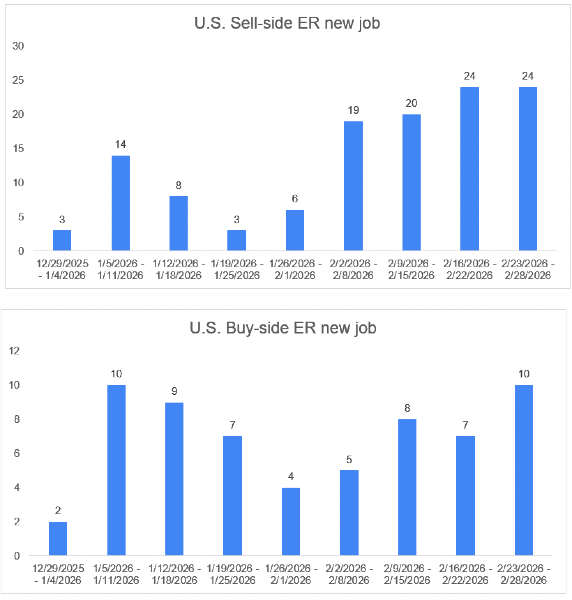
Below are the new buy-side and sell-side research jobs added by week (of course, the week of 2/23 is not over.) Bonus season is clearly underway — and hiring is picking up.
If you're looking to break into the buy-side or sell-side equity research, this is when seats quietly open up.
Don’t miss an opportunity. Join the Job Board and get immediate access to every new role.
Read my other published articles:
📇 Connect with me: LinkedIn | Instagram | Twitter | YouTube
If you want to advertise in my newsletter, contact me
Want my insider takes?
8,000+ readers get my weekly insights on public equity research.