What I Learned Going From Creator to Founder

Reading time: ~15 mins
I often get questions about lessons I’ve learned as a public equity investor-turned creator-turned founder. This series shares those lessons. Whether you’re a corporate employee, an investor, or a founder (especially a creator-turned-founder), I hope you find value in ideas that have reshaped how I think about work, money, and the world more broadly.
This week’s article is sponsored by Endex

Public Equities Professionals Are Training AI Models As Latest Exit Opportunity
Ex-finance professionals are now training Endex, the Excel agent backed by OpenAI. They’re teaching Endex’s models how Wall Street actually builds DCFs and LBOs.
Firms are leveraging AI tools as a path to streamline tasks that used to take investors hours.
Frontier AI labs project significant improvements in Excel capabilities after the next year.
You can request access to Endex or apply to join.
You have to be valuable to make big money
The highest-paid jobs all work the same way: your pay is tied to the value you create.
Investment banking MDs and partners at consulting firms and law firms don’t really care about base salary. They know real money comes from how much business they bring in—and in theory, there’s no cap on that. CEOs are the same. Stock options are what actually matter if they hit their targets. Portfolio managers don’t care about base pay either, because their bonus depends on how much dollar alpha they generate.
The pattern is pretty clear: at the top, pay scales with impact. If your compensation isn’t tied to value creation, you end up spending your entire career chasing higher salary bands—and salary has a hard ceiling. You can now stop complaining about why MDs don’t do slide work or financial modeling, their job is to golf with CEOs in hopes of getting businesses.

Founders are this idea on steroids. You start with nothing. No product. No brand. No distribution. You don’t get paid at all unless customers actually want what you’re building and are willing to pay for it. It’s as real as it gets.
Even coming from a hedge fund, a performance-driven pay scheme, being a founder has made this lesson hit harder. I have to add value. If I don’t, I make $0 and no meals on the table until then.
What does this mean for you?
You need to choose a career where you can add the most value, instead of choosing one that pays the most. If you are not particularly good in the field you chose and the field pays a lot because it adds big value to the world, you won’t get rich along with the industry.
You should live every single second of your life thinking about how to be of value to everyone around you – your family, your friends, your manager, your team, and your firm. The more valuable you are, the market will find a way to pay you - either at where you are today or somewhere else that’s willing to pay you more fairly.
I am able to do what I do today full-time not because I am the greatest investor - I was not in the investing profession for long. I generate enough revenue today because I am resourceful, pay attention (to problems) and take action (more on this point later in this article.)
If you want to be ahead of 95% of your peers in understanding how to get rich, I highly recommend you read my book summary of The Almanack of Naval Ravikant.
Entrepreneurship is way harder than day jobs
There’s a reason why most people work for others—and a reason why most of the richest people in the world are entrepreneurs (or inherited from one).
When you work for a company, a lot is done for you. The product exists. The sales channels are built. The brand is established. There’s stability. Your experience fits neatly into a defined career path you can take to another employer. You get paid a fixed amount, like a bond.

A startup starts with nothing. No product. No distribution. No brand. About 95% of startups fail within five years. It’s stressful, unstable, and often lonely. As a founder, you build everything from scratch with no guarantee it’ll work. You learn to build a product, sell it, create a brand, deal with customers, and comply with laws—all at the same time.
So what do founders get in exchange?
Leverage. Leverage over capital, labor, and distribution—especially today, when the AI and internet have slashed the cost of building and scaling. You hear stories about people working five hours a week and making six figures a month. That’s totally doable. What doesn’t get talked about is the years of 100-hour weeks making $0 to get there.
There’s also equity.
When you retire from a corporate job, back in the day you at least walked away with a defined-benefit pension (no, not that 401K crap) that pays you for life. Today, you walk out the door. Maybe they throw you a retirement party. You can’t sell your seat for cash. Yay.
A business, on the other hand, can have real exit value—assuming it isn’t a melting ice cube. As the business grows, your net worth grows with it.
I doubled my business’s revenue in a single year by launching a new product. When your employer launches a product that doubles company revenue, your salary doesn’t double.
I also don't deal with incompetent managers or needing to hop on "quick calls." when an email can do.
If everyone were capable of building a business that reaches product–market fit, almost no one would choose to work for someone else. It is just, all the perks associated with entrepreneurship are hard
You are no longer evaluated on input
As a founder, the link between effort and income breaks.
When you work for a company, you usually have to put in at least 40 hours a week to earn a fixed salary. As long as you’re not completely useless, you keep clipping that paycheck.
Entrepreneurs don’t get paid at all until they reach product–market fit—and there’s no guarantee they ever will. Customers don’t care how hard you work or how smart you are. If your product doesn’t solve a real problem or isn’t priced right, they simply won’t pay.
That’s both the downside and the upside to the effort-income breakage.
The downside is that effort alone means nothing. You can work nonstop and make zero dollars. The upside is that if you know what you’re doing and produce real results, leverage (capital, employees, internet / AI) allows you to turn your input (knowledge, effort, vision) into 10x or even 100x the financial output.
In that sense, entrepreneurship is a lot like the buy-side. Clients, who entrust their capital with you, don’t care how you generate alpha. You can work 80 hours a week and lose money, or work 10 hours a week and beat the market.

That’s not to say hard work doesn’t matter. In reality, value tends to flow to people who work harder and make better decisions than others.
The reason founders earn most of the upside isn’t effort — it’s ownership and risk. If that feels unfair, the fastest way to understand why it exists is to try starting something yourself. Reality teaches the incentive structure better than any debate.
You cannot only be motivated by money
A while back, at a book club I was attending, I told someone I work full-time on my creator business. She immediately jumped to asking how to start a YouTube channel to make money. All she asked was how much money I make, what products I sell and what's my revenue model, in that order.
I didn’t bother correcting her, but I knew she would likely give up and fail because her mind was at the wrong place.
There’s nothing wrong with wanting to make money. I like money. Who doesn’t? But money is a weak motivator when things get rough for founders and 100% of the time it will get hard. That’s why Jensen Huang wishes you “great amount of pain and suffering.” but there will be lots of it. I attest to that, however miniscule what I do versus what founding Nvidia was like.

I didn’t start Richard Toad to make money. Those who have supported me since before 2022 know that. I wanted to help people with their careers and I was always good at it before I was ultra-niche micro-famous. Over time, that turned into an audience. With 80,000+ followers across the internet, it’s safe to say you like what I have to say.
Going from creator to paid products was not trivial either. People don’t like paying for things (lol—big surprise!) But I made it work, only after two years of making pretty much no money. Today, a lot of the heavy lifting is done by my paying customers, who tell others how my products actually solve their problems.
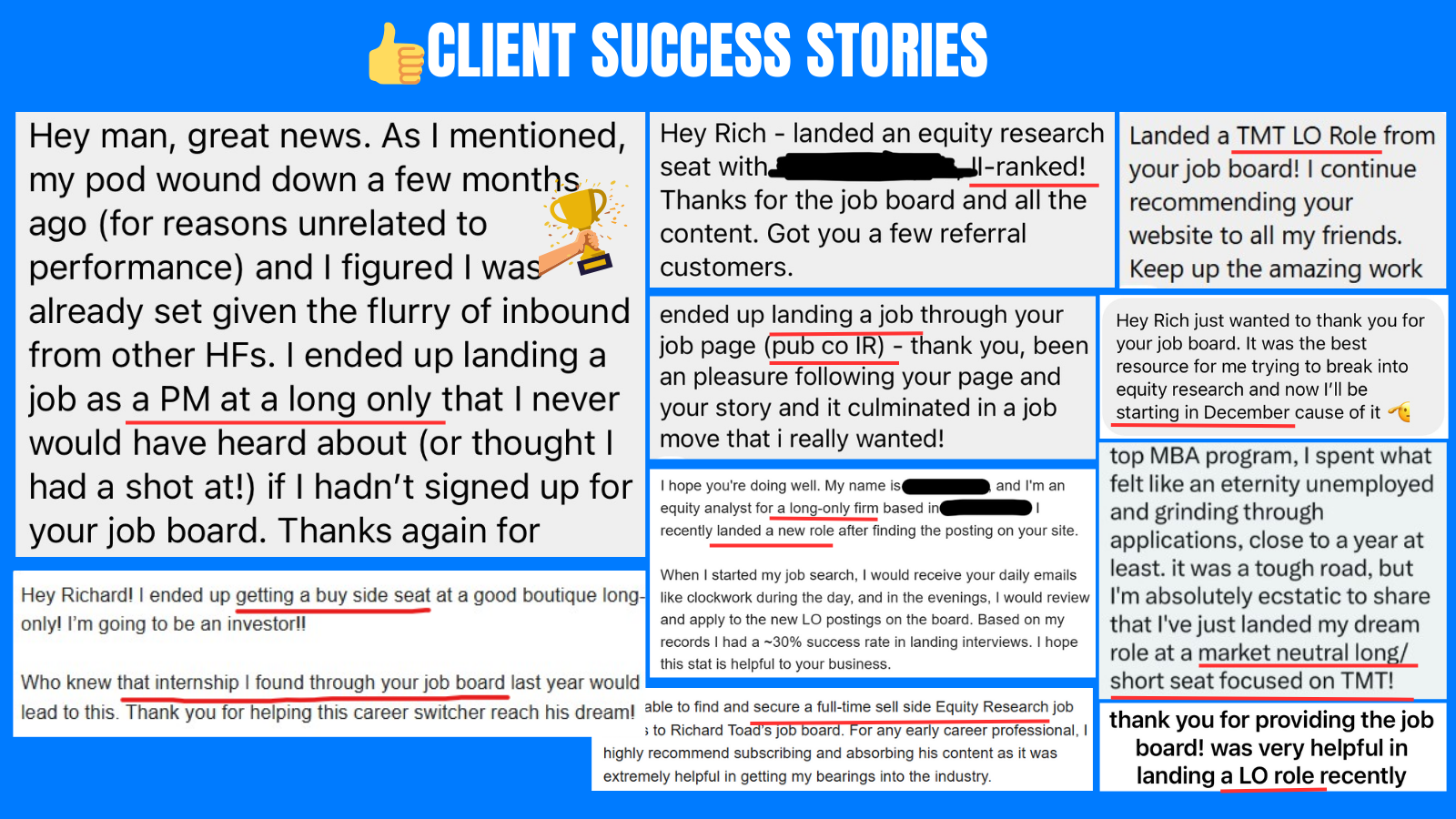
That’s the key point: making money is a byproduct of solving problems well. You can’t build a defensible, long-term business if you don’t first build trust, reputation, and a brand people believe in.
The most dangerous thing about focusing on money too early is that it pushes you into short-term decisions that hurt you long term. You might partner with the wrong advertisers. You squeeze nickels and dimes out of your audience. And in the process, you lose trust—which is almost impossible to get back.
So focus on solving a problem first, then the money will come over time. Even the world’s biggest businesses were started because the founders genuinely want to solve a problem.
You need to act
I’m not smarter than all of you. I just took actions because I had no choice - I quit my hedge fund analyst job without a job lined up and I struggled to land a corporate job.
My first product of selling coaching hours had virtually no interest. I kept pivoting, kept learning from others online, and I have been wildly consistent with content creation all during that time, thanks to having been a creator before being a founder where consistency wins.
That’s my “secret sauce”—and it’s the secret sauce for a lot of people who look successful from the outside. Action is key.
In investing, you can do all the analysis in the world, buy the stock, and still watch it tank. It sucks—but that’s how you learn.
As a creator, you have to post content, look at the analytics, see what gets reach, and double down on a format that works. And then, inevitably, it stops working—because platforms themselves can’t figure the fuck out what types of creators they want to serve. It’s frustrating, but that’s creator life.
Founders live this too. You have to launch the damn product. You will almost certainly run into problems you didn’t anticipate. What matters is your resilience in solving them. That’s what makes or breaks a founder.
Stop thinking and wondering, START. No one pays you for “oh I always thought about starting this business.” Well, you didn’t make it happen. Selling books and making electric cars are easy to say, but Jeff Bezos and Elon Musk made them happen. Bezos had to ship packages himself during holidays in Amazon’s early days and Elon Musk lived in the factory. Everybody wants to go to heaven but nobody wants to die.

My job board today looks nothing like the version I launched in January 2024. I’ve refined it, expanded coverage, removed things, added terms and conditions because of bad actors (more on that in the next point). It’s a great product that sells itself today, but it started with just putting it out there.
So the next time you say you’ve “always wanted” to do something, go do it today. You’re not getting any younger. And the older you get, the more life constraints you will have.
You will deal with bad actors
I’ve dealt with my fair share of bad actors as a creator. But bad actors in creator world are mostly haters. And haters don’t pay my bills. So who gives a fuck about them?
Dealing with bad actors as a founder hits differently — because now money is involved. And I believe price (money) is what you pay and value is what you get. And in every single dispute I have gotten, I believe I did not fail to deliver value.
People show their true colors when they have to pay. Serving early-career professionals, college students, and MBAs doesn’t help either, but I am sure a B2B business just has a different sets of bad actors.
I won’t bore you with all the details, but here’s the short version of how payment disputes impact my job board business. When a customer initiates a chargeback – the payment network (Visa/Mastercard) hits me with a non-refundable $15 fee. It doesn’t matter whether I accept the dispute, fight it and win, or fight it and lose. For a customer paying for one-month subscription at $10 or $12, it’s negative profit no matter what.
Recently, a buy-side analyst disputed two payments for access to my job board. He claimed he cancelled the subscription and still got charged, even though there is no record of him ever cancelling. I make enough money today that I thought, “Fine, I’ll accept it. My time is worth more than preparing documents to challenge the dispute." So I let him keep the two payments.
Big mistake.

Right after I accepted those two disputes, he filed another dispute tied to another past payment of his. That’s when it really clicked: when you give ground, some people don’t stop — they step further into your territory.
So I escalated and disputed the dispute. The verdict is still pending, and I may lose the $12 subscription fee, the $15 non-refundable network fee, AND an additional $15 dispute fee from Stripe if I lose. But the point isn’t the money. The point is making it clear that I’m not a pushover.
And of course, that person is permanently banned.
Going through the bad actors has made me far more aware of things I used to think were just formalities. Terms and conditions matter. Business laws and seeking legal support matter - a lot. They aren’t there for show. As a founder, I constantly update them to account for new ways people try to abuse the system. That’s just the cost of running a real business.
Over time, my dispute win rate has gone up because I now require acknowledgment of my policies. It’s also the key reason I raised my job board price to $19 per month. I only want to work with people who genuinely value what I do and want a real, fair business relationship.
Dealing with bad actors has made me more ruthless. And I’m okay with that.
Recently I read Michael Ovitz’s biography. Ovitz is the founder of Creative Artists Agency (CAA), one of the legendary talent agencies. CAA represented mega stars like Tom Cruise, Steven Spielberg, Leonardo DiCaprio.
When Ovitz started CAA, William Morris, the incumbent talent agency, sued CAA and tried to shut CAA out of the industry. Ovitz survived by playing hardball — redirecting the DOJ’s attention to the antitrust behaviors of the incumbents and forcing a truce. The lesson stuck with me: being “someone you don’t want to fuck with” doesn’t mean being an asshole. It means doing what’s necessary to survive.

The lesson for you: you shouldn’t be an asshole for the sake of it. But you also shouldn’t be a pushover. Bad actors exist in classrooms, in the office, in business, and you can’t eliminate them entirely. What you can do is protect yourself relentlessly — and make sure those people never get another opportunity to be part of your business or your life.
Persistence Isn’t Enough
Just because you don’t give up doesn’t mean you’ll succeed. This is where too much motivational content can actually hurt you.
A successful entrepreneur tells you to start companies. A YouTube coach tells you to keep posting videos. A stock picker tells you to buy single stocks. All are motivated to grow the addressable market by converting you into a believer of their path. Their intentions are good, because giving up is the only sure way to fail.
But they also know the math. Only a small percentage of their audience will ever make it. Outcomes follow power laws (more on that later in this piece). Most people won’t win, even if they try hard. If it were that easy, 95% of people would be founders, not working for others.
Entrepreneurship needs more than grit: you have to use your brain.

Maybe the market just doesn't need what you are selling. Or there are too few customers. When that happens, you don’t “push harder.” You pivot by trying something else. Plenty of successful startups pivoted before they found product-market fit. What you don’t hear about are the ones that kept pivoting and still failed. That’s the brutal part of going from zero to one.
In my case, the market is small and still is: public equity investing is flat to declining. But it’s also secretive, opaque, and wildly fragmented. That opacity gave me an opening to share an insider view. The fragmentation gave me a chance to aggregate job leads and profile employers.
Looking back, starting with 1-on-1 coaching, something that doesn't scale, was fine. However, monetizing right away was the mistake. I sat at my desk every day with no one signing up. I kept posting content, basically shouting into the void: “Pay me to talk to you 1-on-1.” It didn’t work.
Coming from public equities helped in one important way: I was used to actively looking for guidance. I read blogs and watched YouTube videos. Through an old connection, I joined a small founder network. The network fizzled out—but one conversation mattered.
A guy named ZZ was surveying people for something he was launching. I agreed to help. In return, he listened to my business problems. His advice was simple: stop charging. Offer two weeks of free calls. Just listen (to your customers.)

Those two weeks made big progress. My calendar filled up from 8am to 5pm. I learned one big insight: customers have problems, but they don’t know what unless you name them clearly. I started seeing patterns—pitch support, financial modeling, competitive analysis, and more. Once I reflected those problems in my positioning, conversions improved. That clarity snowballed.
Still, coaching itself was never going to be the end product. So I kept exploring.
I spent a lot of time on a finance forum where undergrads asked questions. That’s where I first built an audience. It was also how I followed industry trends after leaving the job myself. In hindsight, the answer was obvious.
During MBA recruiting, I knew research firms don’t post jobs, but I also knew firms do – it’s just they are in 500+ places. Aggregating and filtering job leads was real value. But I didn’t see it at first, because of bias: I thought a “career coach” is supposed to sell coaching.
So I started testing. I posted new job openings using the same workflow I used during MBA recruiting and shared them daily in my newsletter. Subscriber growth picked up immediately.
My friend Justin pushed me to turn the job board into a paid product. The timing was perfect. ChatGPT had just launched. I used ChatGPT to vibe-code a job board using HTML and JavaScript.
Money started coming from happy first adopters. I continued to market it daily on my social media. That was product-market fit—and how I went full-time as a creator by building a subscription business.
The whole journey was messy. Lots of zig-zags. No single right answer. Just a few key moments that moved everything forward.
Persistence helps. But you have to think, learn, and act at the same time.
Power Law and Critical Mass
I like philosophy. Not for fun—this is just how I learn. Two concepts are relevant in business and the creator economy: power law and critical mass.
Power law is the idea that a tiny number of inputs drive most of the outcomes. Looking back, really only 2-3 decisions each year pushed my business forward in a meaningful way.
- Launching the job board was the decision that moved me from an unemployed content creator to a self-employed founder with real income and growing leverage.
- Ten pieces of viral content are responsible for more than 90% of my new followers in a year.
- About 5% of my audience are paying customers that put meals on my table. The rest? I am renting their attention. As long as I serve the 5% well, I will grow my business – power law.
- Ask a hedge fund founder what drives their P&L and they’ll usually say three to five positions explain most of their performance in a year.
Power law shows up everywhere in life.
The second idea is critical mass.
I always use boiling water as an example. You can turn the heat up and nothing happens for a long time. Then suddenly, it boils. After that, you can turn the heat off and it’ll keep bubbling for a moment.

That’s critical mass (also called a boiling point or escape velocity.) It’s what happens when a business finds product-market fit. It’s what happens when a creator finds content-audience fit. When it works, it grows exponentially.
Last year, a few viral moments on Twitter led to a Bloomberg report's attention. A Bloomberg article last January brought me six months’ worth of paid subscribers in a single day.
What people didn’t see was years of work with almost no progress. That’s critical mass: one visible event that’s really the result of a long buildup.
My creator journey followed the same pattern. The beginning was brutal. When you have zero followers, getting views is hard. I kept posting anyway, because every post gets shown to strangers. Eventually, a big account noticed my work and reposted it to tens of thousands of followers. Then equity research associates started following me. They reposted my old content. Suddenly I had my own distribution and growth accelerated fast. When it rains, it pours.
Media loves to frame success as an event. It never is. Some of the most successful companies made no money for years before things clicked. For example, Dylan Field's Figma generated no revenue for four years. Those four years are not wasted, they led to the product-market fit.
Power law explain why only a few decisions matter. Critical mass explains the importance of unseen compounded effort.
Learn to Sell
Creators who started businesses don’t start from zero. We have the distribution but no product. You’d think once you find product-market fit, money just starts rolling in.
Not quite.
There are a few hard truths to remember.
First, being a little famous doesn’t mean people want to pay for something you’ve (or others have) been giving away for free.
Second, exchanging money for value is sacred. Customers are right to be skeptical. They want to know if your product solves their problem, because they have limited money to allocate to things that add value to them. Third—and you only learn this by doing—buying decisions are often emotional, not rational.
That’s why you need to learn how to sell.

Selling is about appealing to the emotional side of the brain. This isn’t manipulation. If people don’t believe your product has value, they won’t use it—and you cannot help them. Selling well lets you make impact and earn money.
The good news is tips on how to sell is everywhere. Read classic copywriting books. Study how great products explain themselves. Then apply what you learn to your product pages.
Incentivize users to leave reviews. Show those reviews publicly. Social proof lowers fear and brings in early adopters.
From there, the flywheel starts. People get value - they land jobs from my products and then tell others. Success stories bring their classmates and colleagues. Business grows and my impact grows.
Learning to sell isn’t just important for entrepreneurship—it’s a life skill. You’re selling every day whether you realize it or not: dating, promotions, influencing corporate decisions, and so on.
As long as you deal with other humans, selling matters. As a founder, it’s not optional. Today, I spend less time building new products and more time marketing and distributing the ones that already work—because revenue grows when selling gets better.
Learn From Others
One advantage of coming from the buy-side is learning to be proactive. Most of the time, I still don’t know exactly what I’m doing. I’m just less scared now.
That’s because I know two things. First, I’m allowed to be wrong and fix it. What I build isn’t mission-critical. No one dies if I mess up. This isn’t a heart pump or a car. Second, I know who to learn from. I can study people by consuming their free or paid content. Alex Hormozi, Dan Martell, Justin Welsh, and many more.
If you’re the kind of person who waits for instructions, entrepreneurship probably isn’t for you. Early on, you have to do everything yourself. Literally everything. You can’t afford to outsource. And even if you could, outsourcing before you understand the details creates a fragile business. The moment something breaks, you lose customer trust—and you won’t even know why, because you weren’t involved from the start.
In both my creator and founder journey, I learned by watching others. I studied creators like Vanessa Lau, Ali Abdaal, Think Media, Matt McGarry (the newsletter guy), and I also learned from the year-end reviews of other financial creators.
The information is out there, but remember: every business and creator is different. For example, just because my job board works doesn’t mean someone serving the AI industry can sell one. AI jobs are everywhere. You can find them easily on LinkedIn. The same goes for investment banking. Off-cycle roles are rare, and on-cycle recruiting is so structured that a job board isn’t needed. Paying for job boards doesn’t make sense if you are recruiting for AI or IB.
Learn from others, but don’t copy blindly. What works is deeply tied to the niche, the timing, and the problem you’re solving. You can borrow ideas. You can’t borrow context.
Buying Back Time
One of the biggest growth unlocks for me as a founder was understanding the power of buying back time.
At one point, I was overwhelmed by hundreds of small tasks every day. None of them were particularly hard, but together they were exhausting. Worse, they didn’t make me better at my actual edge: understanding the public-equity investing ecosystem and communicating it clearly.
On a call with a buy-side analyst who was also running a successful faceless educational YouTube channel, I complained about how draining this felt. His response was simple: read Buy Back Your Time by Dan Martell. That book reframed how I thought about work, delegation, and leverage.
The core idea is straightforward. Your time should be spent on the activities that actually compound—strategy, relationships, and high-leverage creation. Everything else should be systemized and delegated.
Once something works, you document it. You write down the process step by step. That process becomes the manual you hand off to someone else so you can remove yourself from execution without breaking the system.

Today, I work with contractors who handle social-media automation and data gathering. I record short instruction videos, maintain clear workflows, and let a virtual assistant execute the daily tasks. This has freed me to focus on building relationships for the job marketplace and creating exclusive content for paying subscribers.
If you think about it like an investor, the math is obvious. Paying $500 a month to outsource work that leads to $4,000 in incremental revenue is not an expense—it’s a return-generating investment.
The lesson is simple: be willing to spend money to outsource low-value work. That’s how you buy back time. And buying back time is how you build something that can grow beyond you.
Conclusion
At the end of the day, turning a following into a business isn’t about hacks, luck, or being smarter than anyone else. It’s about creating real value, acting instead of overthinking, earning trust before monetizing, and being disciplined enough to protect what you build. The upside—ownership, leverage, and independence — comes with real risk and responsibility.
Thanks for reading. I will talk to you next time.
Please note: when I refer to “working for a company,” I’m specifically talking about roles without a meaningful variable compensation component. That excludes positions like sales, investment banking, or hedge fund roles, which sit in a gray area between traditional employment and entrepreneurship because pay is at least partially tied to value creation.
Want my insider takes?
8,000+ readers get my weekly insights on public equity research.