
The Hidden Reasons Hedge Funds Reject You


It has been two weeks since the final round interview for a hedge fund job you really wanted. You start to get anxious and debate whether you should follow up. Then you say fuck it, and you do. Your contact at the fund tells you that you didn't get the offer. You ask for feedback. They say you were a great candidate but they went with someone else. That's it.
You might have been the best investor in the room and still weren't going to get that offer. Not because of your stock pitch. Because of something else entirely. And most won’t say it out loud. So I will.
Immutable truth about hedge funds
Most hedge funds have a small investment team. The decision to bring in someone new is deeply personal, which is why funds are so risk-averse when hiring juniors and why the interview process is always so long.
At my former employer when I started, there were four of us dudes. By the time we added another investment person, I joked about calling ourselves Five Guys Capital Management. The industry is male-dominant and certain communities are outsized in their representation - which has real implications for candidates who don't fit the typical profile.
I am fresh-off-the-boat Chinese - so I have been an atypical profile the moment I landed in this country, which paradoxically instill the self-awareness in me to adapt to different crowds.
In hedge fund land, you are not applying to a company with HR processes, diversity committees, and a formalized hiring rubric. The hedge fund founder is an absolute monarch. You're trying to get invited into a small, opinionated family. And families pick based on gut.

If you just want the two main takeaways: first, the biggest lever you control continues to be becoming a better investor. Second, learning how to relate and be liked can enhance your candidacy.
Now, if you are curious as to what are the non-skill reasons you didn't close that hedge fund job offer - read on.
Ageism and gender
Hedge fund is a young person’s game.
Long hours favor the young. Information processing does slow with age. Chronic stress is hard on health. And an older candidate with family obligations and financial commitments may reasonably want the kind of stability that the buy-side's boom-or-bust compensation structure doesn't offer. Funds also worry you'll leave when things get volatile.
About half of the highest dollar earning hedge funders in the world in 2025 no longer make investment decisions at their respective firms. They have leverage out of their juniors, you don’t.
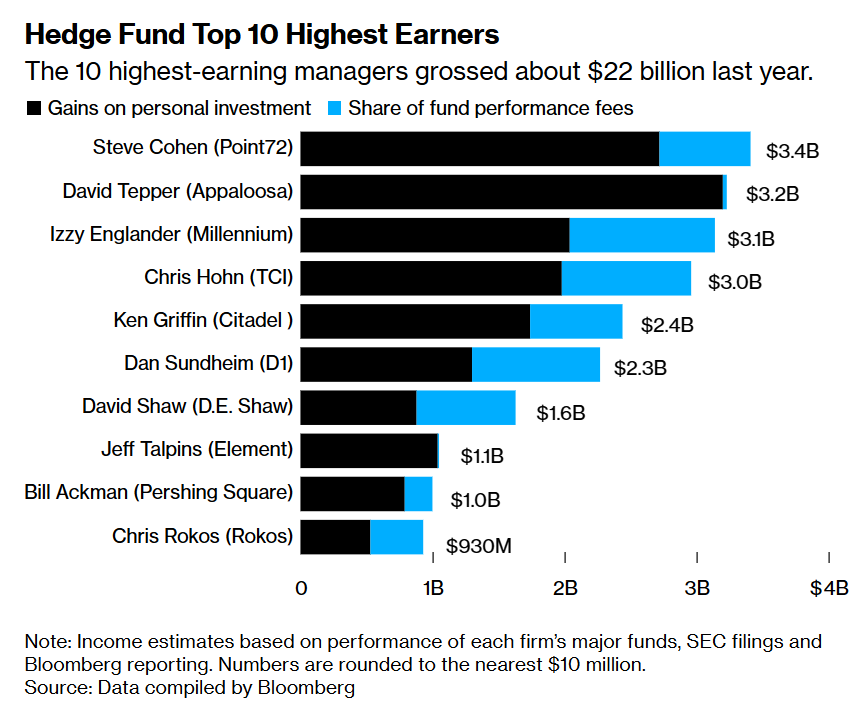
There's also the awkward dynamic of seniority inversion. If you're in your 40s and the founder is in the 30s, that adds a layer of weirdness most PMs won't navigate deliberately - they'll just pass. In a performance-driven industry, a young PM doesn't need life lessons from someone who's lived more years than he or she has.
Same goes for gender: the hedge fund industry has failed to create a good work environment for women. Tragically, I know some women self-select away from buy-side careers partly because of that. Hedge funds end up with fewer women, which perpetuates fewer women - and creates the additional irony of firms hesitating to hire women out of genuine concern about how they'll be treated in an all-male environment.
Race and politics
The advice here is blunt: don't volunteer political or ideological affiliations that introduce controversy when your goal is connection. If something on your resume could become a topic of debate rather than a bridge, consider whether it earns its place there. You have more to lose than gain.
Two years ago, a client struggling to break into the buy-side booked a coaching call with me. He had a stellar LinkedIn profile. So I asked him to send his resume. He had listed a highly polarizing political student org on it. That line tells me nothing about his ability to generate alpha, and it clearly hurts him on fit – not worth it.

English fluency is evaluated in roles that involve communicating with the PM, management teams and representing the firm. For a non-native speaker (like myself), an accent alone is never disqualifying, but communication barriers, real or perceived, factor into hiring decisions. Nobody will tell you this. You might not completely eliminate an accent, but you can sharpen your communication by reading and writing consistently and speaking in front of people - or posting video content online.
They just didn't like you
Every hedge fund decision-maker has a precise mental image of the candidate they want, often without knowing it themselves. The mismatch can be investment philosophy. It can also be something as arbitrary as the wrong sports team on your resume. A fund is evaluating whether they want to spend long hours at work and on the road with you. The airport test is not a cliché.
I once interviewed with a long-only that was a strong style fit, with a close friend vouching for me inside the firm. I could tell the Director of Research simply didn't like me. The feeling was mutual, and I knew it before I'd pitched a single idea. I didn't advance past the first round. A year later, I got a second shot at the same team with different interviewers but the same Director of Research, same outcome. Sometimes the fit isn't there and you cannot fix it.
I've reviewed client resumes listing team affiliations as hobbies. Like political beliefs, that information can hurt you more than it helps. (Plus, sports teams are not hobbies)
Maybe you thought listing Barcelona FC as a hobby would be a conversation starter - but what if the PM is a die-hard Real Madrid fan? I've seen clients list the Green Bay Packers, which does nothing for you if the PM bleeds Bears blue. The decision is asymmetric to the downside. Adding that information can only hurt; it cannot help. The PM will never disclose it as a reason for rejection.

My tip: Identify one or two areas - travel, sports, food, film - where you can hold a real conversation with people at the fund. You need to be someone they'd actually want around.
Sometimes you need to read the room and be agile. I am not sure I can help you that.
I once interviewed with four long-only PMs in the same room. I knew they owned Carvana. One of the PMs asked me whether Carvana was a buy. I made a snap decision to agree because at the time I was genuinely bullish on its business model. He smiled and said "good answer."
The lesson is: many buy-side investors preach independent thinking while carrying significant ego and bias. Get the job first. Be a contrarian once you're inside.
Elitism
Hedge fund founders who came from Harvard, BB IB and MF PE love to hire from the same background because it worked for them, and because it provides institutional cover if the hire doesn't pan out.
The same logic applies to LPs: giving more capital to a Tiger Cub is the defensible choice even if it underperforms. Backing a $100 million AUM fund is a career risk even if it outperforms.
Another point: growing up around money makes you fluent in the social language of money management. How you carry yourself, what you know, how you interface with a wealthy executive or an LP - these things compound from early exposure. None of it is fair. I was outside that world and still am, but I know it well enough because understanding it is my entire job today and my brand. It's doable.
The resources exist to close these gaps. If you know the biographies of the major fund founders, understand their lineages, and can hold an informed conversation about who built what from whom, you will be perceived as being “on the inside.”
"Firm decision"
Some rejections have nothing to do with you.
Hedge funds post fake jobs to source free stock ideas. Is it unethical? Yes. What can you do about it? Nothing, because there are always more candidates than hedge fund job openings.

Internal candidates already have the job locked up - you were the market check to confirm they weren't missing a stronger external option.
Nepotism happens. An LP texts the founder "my daughter wants to work in investing", the hedge fund founder can't say no. The role you prepared hard for goes to someone whose parents made a phone call.
And sometimes a fund is quietly in crisis - a major redemption, a key PM left, a portfolio blowup - and the job posting went live before the bad news broke internally. By the time you're interviewing, the hiring is already dead. They just haven’t pulled the job listing.
Also bad luck happens. The PM was down 5% that morning. Three strong candidates interviewed the same day. You were the fourth.
The Senior Analyst who ran your first-round phone screen was a colossal a-hole and dinged you before you ever reached the PM who might have loved you.
Nothing you can do here. The only answer is more shots on goal - which means building a network and not treating any single process as the one that mattered.
Conclusion
Even the best get rejected.
Stephen Schwarzman was rejected by Harvard and made sure Harvard remember that mistake. Michael Jordan was cut from his high school varsity team. Jack Ma couldn't get a job at KFC.
The buy-side job search is not a clean meritocracy, but it’s more meritocratic than many industries.
It comes back to the two things you can control: you as a product, and how you sell yourself - which, in this context, means learning how to be liked.
I hope this helps. Let me know if you have comments. I will talk to you next time.
Quick news: I made an effort for my premium content to be more accessible, so I added a tier for those who only want to read the fund deep dives and stories of famous hedge funds that went out of business, without access to my quarterly updated fund database. Check out the now two offerings.
Want my insider takes?
8,000+ readers get my weekly insights on public equity research.


